
Bilawal has said the reality is that his party does not have a mandate to form a federal government.

The crucial talks between the top leaders of Pakistan's ruling coalition ended inconclusively on Friday, with Pakistan People's Party co-chairman Asif Ali Zardari seeking more time from his ally Pakistan Muslim League-N chief Nawaz Sharif, to consider the modalities for reinstatement of the deposed judges. Sharif said that his party remained committed to the restoration of the judges sacked by President Pervez Musharraf, by May 12. Zardari did not talk to the media.
With the 30-day deadline for restoring the judges expiring on Wednesday, senior leaders of the two parties, including Sharif and PPP co-chairman Asif Ali Zardari, are trying hard to sort out their differences on modalities. Some progress was made during the talks, but there were unresolved issues, Sharif said adding, he expects the negotiations to conclude on Thursday.
The Pakistan government's coalition partners - PPP and PML-N - have 'agreed' to reinstate the judges sacked by President Pervez Musharraf in 2007, PPP chairman Asif Ali Zaradari said. The coalition partners had agreed to finalise modalities for restoring the judges in 30 days of assuming power. The deadline expired on Wednesday.
Bhutto's planned long march, which will traverse a distance of nearly 300 km, is expected to be the PPP's largest show of strength since her homecoming rally in Karachi on October 18 that was marred by a suicide attack, which killed nearly 140 people and injured hundreds more.

Nine candidates on Wednesday filed nominations for Pakistan's presidential election, with the ruling Pakistan Muslim League-Nawaz's India-born nominee Mamnoon Hussain emerging a clear frontrunner for the poll to be held on July 30.
The decision was taken by the Opposition alliance, the All Parties Democratic Alliance, headed by Sharif's Pakistan Muslim League-N at a meeting in Peshawar.
The stage is set for talks between Asif Ali Zardari and Pakistan Muslim League - N chief Nawaz Sharif on a draft parliamentary resolution for reinstating judges, sacked last year by Pakistan President Pervez Musharraf, with the arrival of the Pakistan People's Party co-chairman in London on Thursday. Besides the question of judges' restoration, the two leaders will also review national and political developments.
Pakistan's Supreme Court on Friday acquitted former prime minister Nawaz Sharif of hijacking charges, stemming from the military coup against his government in 1999, paving the way for his return to electoral politics. Sharif had been banned from office by a lower court after being found guilty of hijacking the then army chief General Pervez Musharraf's plane in 1999.
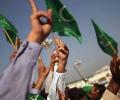
Notwithstanding India's objection, Pakistan on Monday held legislative assembly elections in the strategic Gilgit-Baltistan region amid tight security.
Opposition parties allege the visit was aimed at 'capping' the country's nuclear programme ahead of President Musharraf's visit to the US.
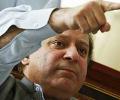
Pakistan Prime Minister Nawaz Sharif's ruling Pakistan Muslim League-Nawaz has emerged as the single largest party in the legislative assembly elections in the strategically-located Gilgit-Baltistan region.

Sharif has been deported to Saudi Arabia.
The Pakistan Muslim League-N, headed by former prime minister Nawaz Sharif, has decided to pull out of the coalition government in Pakistan over the judges row.Several rounds of talks between the PML-N and the Pakistan People's Party, which heads the coalition government, have hitherto failed to resolve the issue of restoration of judges, sacked by President Pervez Musharraf during last year's emergency. However, Sharif added that the PML-N would remain in the coalition.
Chaudhary Shujat Hussain had served as home minister under deposed prime minister Nawaz Sharif. His brother Pervez Elahi is the chief minister of Punjab province, which has the largest number of members in Pakistan's parliament.

Pakistan's embattled former military dictator Pervez Musharraf has refused to leave the country on "medical grounds" until he is given "clean chit" in high treason and other cases, according to a close aide.

'Imran Khan's rule was dismal. Despite this, he has become a cult figure.' 'He sold the dream of a Naya Pakistan to the people of Pakistan, especially the youth, and branded all other politicians as corrupt.' 'Hence, his popularity.'

India's new high commissioner in Islamabad goes to Pakistan at a time when the country is set to face much internal tumult.

But it is less adventurous. It seems, at last, that in its eighth decade, Pakistan has settled into being a parliamentary democracy just like Bangladesh has and like we have always been, observes Aakar Patel.

With the Sharif family set to return to power in Pakistan amid the fast-deteriorating economic situations and political instability, it is to be seen if Shehbaz Sharif infuses fresh energy into the system, or the much-tainted family continues to resort to its old ways.
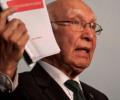
In India, Sartaj Azizis respected as a man of grace, wit and patience. He is a wizened soldier of many diplomatic battles between the two neighbouring nations

Khan's government will be the third consecutive democratic government in Pakistan since 2008.

Being a son of Nehru's dentist is not the only connection that Alvi has with India. He is yet another president whose family migrated to Pakistan from India after partition. His predecessors Mamnoon Hussain's family came from Agra and Pervez Musharraf's parents migrated from New Delhi.

Pakistan-India bilateral relations remained frozen for the fourth year over the vexed Kashmir issue but analysts hope the strained ties could be repaired if Nawaz Sharif becomes the prime minister for a record fourth time in the general elections in February in the absence of his main challenger Imran Khan who is in jail in multiple cases.

Shehbaz, the 70-year-old younger brother of former three-time prime minister Nawaz Sharif, has served as chief minister of the country's most populous and politically crucial Punjab province thrice.

Last year, Maryam Nawaz accompanied her father to Washington, but played a role beyond being the dutiful daughter. She was 'discovered' by the White House, and was hosted by Michelle Obama.

Mamnoon Hussain, the India-born nominee of ruling Pakistan Muslim League-Nawaz, is set to become the 12th president of Pakistan on Tuesday, succeeding incumbent Asif Ali Zardari.

A grieving Pakistan's policy shift towards the Taliban has comes at a great cost, says Shahzad Raza.

Nadeem Hotiana, Pakistan Embassy spokesman in Washington, confirmed the country was now looking for a paid lobbyist "but has not yet taken any decision", the Dawn reported.

How long can Pakistan remain neutral in the Saudi Arabia-led Yemen conflict?
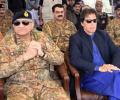
'It is not difficult for a Pakistan army chief assisted by the deep state to manipulate a situation.' 'Pulwama, Uri and Pathankot, all come to mind,' cautions Lieutenant General Syed Ata Hasnain (retd).

Sharif is in London with his ailing wife Kulsoom, who is suffering from throat cancer and has undergone three surgeries so far.

The India card is now almost obsolete. There are more pressing challenges. People of Pakistan are fed up with years of bad governance, corruption and broken promises of successive governments. However, the politicians and former generals are still provoking sentiments on what is happening on the Line of Control for petty political gains, says Shahzad Raza.
Bilawal Bhutto's political inheritance is his biggest asset as well as the biggest liability as he tries to make his mark in Pakistan politics. Challenging the Taliban militants is part of that strategy, though it matches with his political ideology. Shahzad Raza profiles the son of Benazir Bhutto and Asif Ali Zardari.

The 'surgical strikes' by India have made the army in Pakistan look unprepared. To prove itself the army will need to hit back: It could be in Kashmir or outside

Abbasi will run the government until Sharif's brother Shehbaz is elected as member of parliament

Authorities arrange helicopters to shift Sharif to jail; 300 PML-N workers arrested.

A lot of the terrorism that is affecting Pakistan is really a blowback of the Pakistani state's policy of using jihadist groups as instruments of state policy. And unlike some other countries with similar policies, Pakistan doesn't have the benefit of the political and social space for pulling back from the disastrous course, says Sushant Sareen.
'What the long term repercussions of the Ayodhya judgment are will unfold in time.' 'And I hope the consequences are not going to be as damaging to us as they were to Pakistan,' says Aakar Patel.
 © 2026 Rediff.com - Advertise with us - Disclaimer - Privacy Policy - Sitemap - Feedback - About us - Terms of use - Grievances